
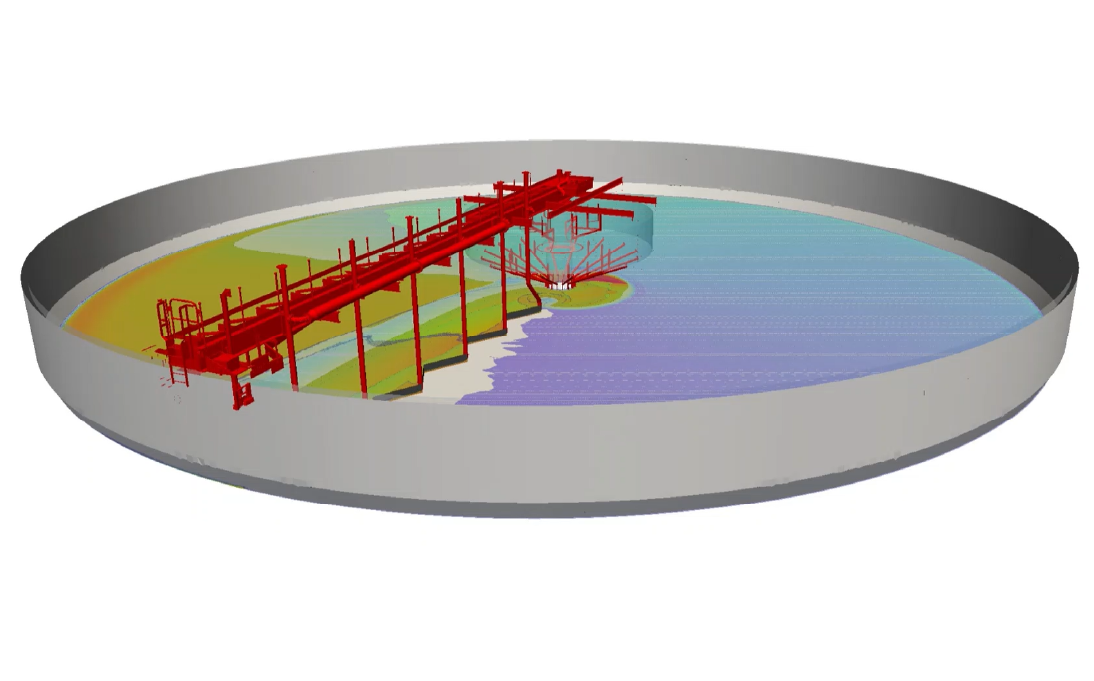
In the UK water industry, regulatory asset management plan (AMP) cycles create a relentless drive for efficiency. Water utilities and their engineering partners must continuously maximise the performance of existing infrastructure and de-risk capital upgrades for new assets. This is especially critical in complex processes like activated sludge treatment, where operational performance directly impacts environmental compliance and capital expenditure. High-fidelity wastewater treatment CFD has emerged as an indispensable tool for achieving these goals, providing deep physical insight that goes beyond traditional design methods.
The Challenge of Modelling Complex Multiphase Flows in WWTPs
Wastewater Treatment Plants (WWTPs) are fundamentally multiphase environments. The behaviour of activated sludge — a mixture of water and biological solids — is governed by complex, interacting physics including fluid dynamics, turbulence, solids transport, and settling. Accurately predicting how this sludge will behave under varying hydraulic loads and process conditions is a formidable engineering challenge.
Traditional design approaches often rely on empirical rules-of-thumb, which can lead to over-engineered, inefficient, or non-compliant assets. Physical scale modelling is expensive, time-consuming, and offers limited insight into the underlying flow structures. This is where advanced simulation offers a transformative advantage, allowing engineers to test and validate design modifications in a virtual environment before committing to costly capital investments.
How HELYX’s Drift-Flux Model Provides an Efficient Solution
To address the specific challenges of the water sector, ENGYS has implemented a specialised drift-flux model within its open-source CFD software, HELYX. This model provides a robust and computationally efficient method for simulating multiphase flows where one phase (solids) is dispersed within a continuous phase (liquid).
The drift-flux approach is a reduced-order Eulerian model that assumes the dispersed solid particles move with the bulk mixture velocity, plus a prescribed relative slip velocity. This simplification significantly reduces the computational cost compared to a full Euler-Euler model, making it practical to run the large-scale, long-duration transient simulations required for WWTP analysis. HELYX’s robust drift-flux multiphase model is purpose-built to handle water flow, turbulence, sludge transport, and the critical physics of settling velocity with exceptional stability.
Integrating Key Physics: Hindered Settling & Sludge Rheology
A key strength of the HELYX implementation is its integration of industry-standard empirical models that define the physical behaviour of activated sludge. This grounds the CFD simulation in decades of real-world process engineering knowledge.
HELYX implements the widely used Takács et al.1 settling model, which extends the original Vesilind2 formulation to accurately represent both flocculent and compression settling regimes. To define the settling parameters, the model directly incorporates correlations for Stirred Specific Volume Index (SSVI) from established sources like Pitman3 and White4. Furthermore, the framework can account for the complex non-Newtonian properties of sludge by using advanced rheological models, including those developed by Bokil and Bewtra5 and Herschel and Bulkley6.
Case Study 1: Resolving Final Settling Tank (FST) Inefficiencies
In partnership with specialist consultancy CER Technologies, ENGYS applied this powerful wastewater treatment CFD methodology to optimise critical assets for major UK water utilities. One project focused on improving the performance of a Final Settling Tank (FST) that was failing to meet regulatory compliance.
The Problem: High Effluent Suspended Solids & Non-Compliance
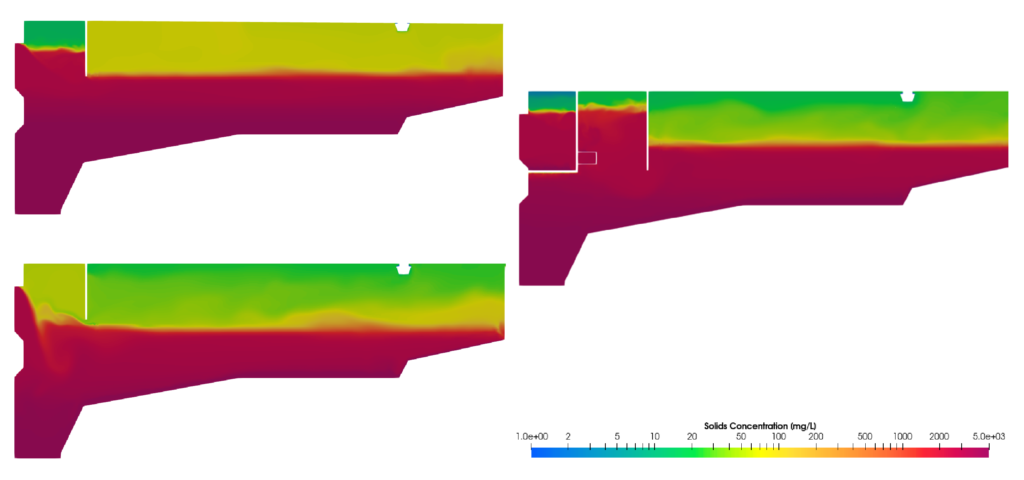
The as-built FSTs, with a diameter of 34.44 m, were consistently producing effluent with suspended solids concentrations > 50 mg/L. This exceeded compliance limits, particularly at high hydraulic loads, posing a significant operational risk. The existing stilling well was found to be ineffective at dissipating the inlet momentum, leading to high velocities and sludge blanket disturbance.
The CFD-Driven Solution: A Redesigned Inlet Device
Engineers used HELYX to model the baseline performance and then test a proposed solution: installing a bespoke Energy Dissipating Influent (EDI) device. The CFD model consisted of a 3D axisymmetric 30° wedge, enabling efficient yet accurate simulation of the tank’s hydraulics. Using the Takács hindered settling model with parameters derived from Pitman and White correlations for various SSVI values, a series of transient simulations were performed.
These simulations, run for 15-20 hours of operational time, allowed the sludge bed to develop fully and provided clear predictions of effluent quality under different flow rates and mixed liquor suspended solids (MLSS) concentrations. The simulations provided confidence that the new EDI, featuring two rows of counter-rotating ports, would effectively manage inlet energy.
Quantifiable Results: Slashing Effluent Solids to Meet Compliance
The results of the CFD analysis were definitive. The simulations predicted that installing the CFD-optimised EDI device would dramatically improve solids capture. After the physical installation was completed based on the simulation results, real-world performance validated the model’s predictions: effluent suspended solids were reduced to < 30 mg/L, bringing the asset back into full compliance even at its hydraulic limit. This is a clear example of final settling tank optimization driven by targeted simulation.
Case Study 2: Eliminating Process-Critical Back-Flow in Mixing Tanks
Another project involved the design validation of a new Activated Sludge Plant (ASP) with four sequential mixing pockets. The goal was to ensure proper flow distribution and avoid short-circuiting, which could compromise the entire biological treatment process.
The Problem: Severe Short-Circuiting in a New Tank Design
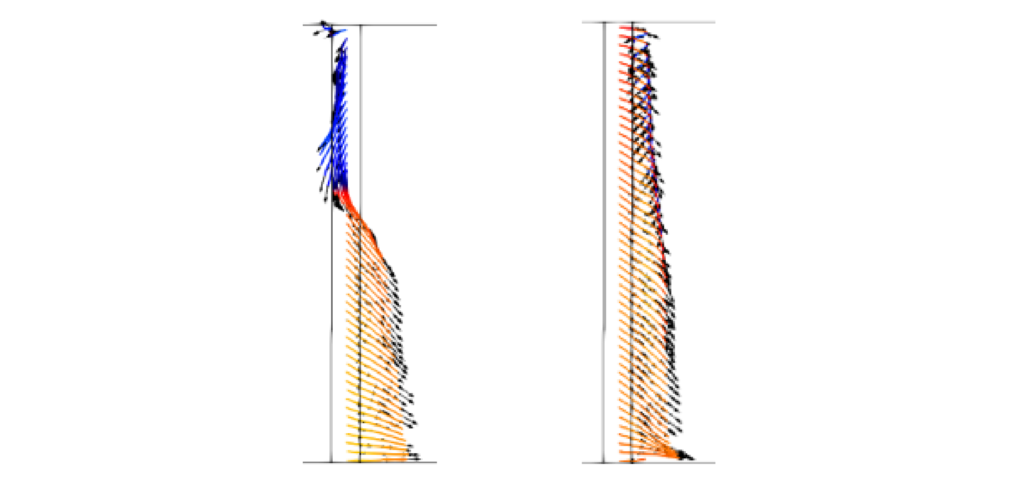
Initial CFD analysis of the proposed design revealed a critical flaw. At Dry Weather Flow (DWF) conditions, a staggering 37% of the total flow was short-circuiting backwards over a central weir between the anaerobic and anoxic zones. This process-critical back-flow would severely inhibit the plant’s nutrient removal capability and render the design unworkable.
The CFD-Driven Solution: Optimised Mixer & Weir Configuration
Using a full 3D HELYX model of all four mixing zones, engineers tested a series of low-cost design modifications. The submersible mixers, modelled as sources of thrust, were re-oriented, the height of the central weir was increased by just 20 mm, and a 90° elbow was added to the RAS inlet pipe.
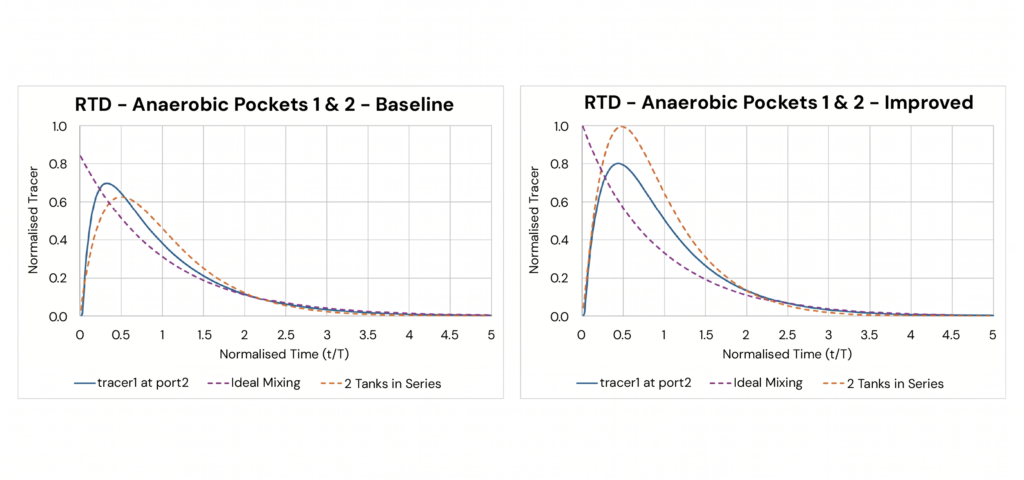
Steady-state analyses confirmed the new flow distribution, while transient simulations were used to conduct residente time distribution CFD tracer studies. These RTD plots provided a clear quantitative measure of the hydraulic efficiency of the tank, confirming the elimination of short-circuiting and ensuring the design would function as intended. The process involved accurate mesh generation for complex geometries to precisely capture the weirs and internal pipework.
Quantifiable Results: Reducing Back-Flow from 37% to Zero
The CFD-guided modifications were remarkably effective. The simulations demonstrated a complete elimination of the process-critical back-flow, reducing it from 37% to 0%. This intervention, performed entirely in the virtual environment, allowed the engineering team to correct a major design flaw before any concrete was poured, saving significant time and capital expenditure.
De-Risk Capital Upgrades with Validated CFD Simulation
These case studies highlight the immense value of applying a validated and robust wastewater treatment CFD approach to the design and optimisation of WWTP assets. By combining the computational efficiency of the drift-flux method with industry-validated settling and rheology models, HELYX provides engineers with a reliable tool to de-risk capital investment and maximise the performance of existing infrastructure.
“ENGYS has been my partner in delivering CFD work for water industry projects over 6 years serving clients in the UK including: Severn Trent Water, United Utilities, Scottish Water – their framework partners and technology developers: MWH Treatment, Volkerstevin, Jacobs and Evoqua Water Technology (now part of Xylem). ‘I can highly recommend ENGYS as an extremely committed, innovative, diligent and very knowledgeable team,‘ explains Chris Robinson, Director of CER Technologies. ‘They have built tested and applied the specialist CFD models that we use for the water industry and a client can have a lot of confidence in them.“
The ability to conduct detailed “what-if” analyses allows for the optimisation of everything from inlet structures and baffle designs to mixer placement and weir heights. This level of insight ensures that capital is spent effectively, assets operate reliably, and regulatory compliance is maintained.
To learn more about how open-source CFD solutions for hydraulics & wastewater with HELYX can optimise your assets, contact our team for a consultation.
References
- Takács, I., Patry, G.G., Nolasco, D. (1991), A dynamic model of the clarification-thickening process, Water Research, Volume 25, Issue 10, Pages 1263-1271, ISSN 0043-1354. ↩︎
- Vesilind, P.A. (1968), Theoretical considerations: Design of prototype thickeners from batch settling tests, Water and Sewage Works, 115 (July), 302-307 ↩︎
- Pitman, A.R. (1980), Settling Properties of Extended Aeration Sludge, 1. Wat. Pollut. Control Fed. 52(3), 524-536. ↩︎
- White, M.J.D. (1975), Settling of Activated Sludge, Technical Report TR11, Water Research Centre, Stevenage, UK. ↩︎
- Bokil, S.D., Bewtra, J.K. (1970), Behaviour of Mechanically Blended Return-Sludge in Absence of Substrate. Water Quality Research Journal; 5 (1): 34-54. ↩︎
- Herschel, W.H., Bulkley, R. Konsistenzmessungen von Gummi-Benzollösungen. Kolloid-Zeitschrift 39, 291–300 (1926). ↩︎