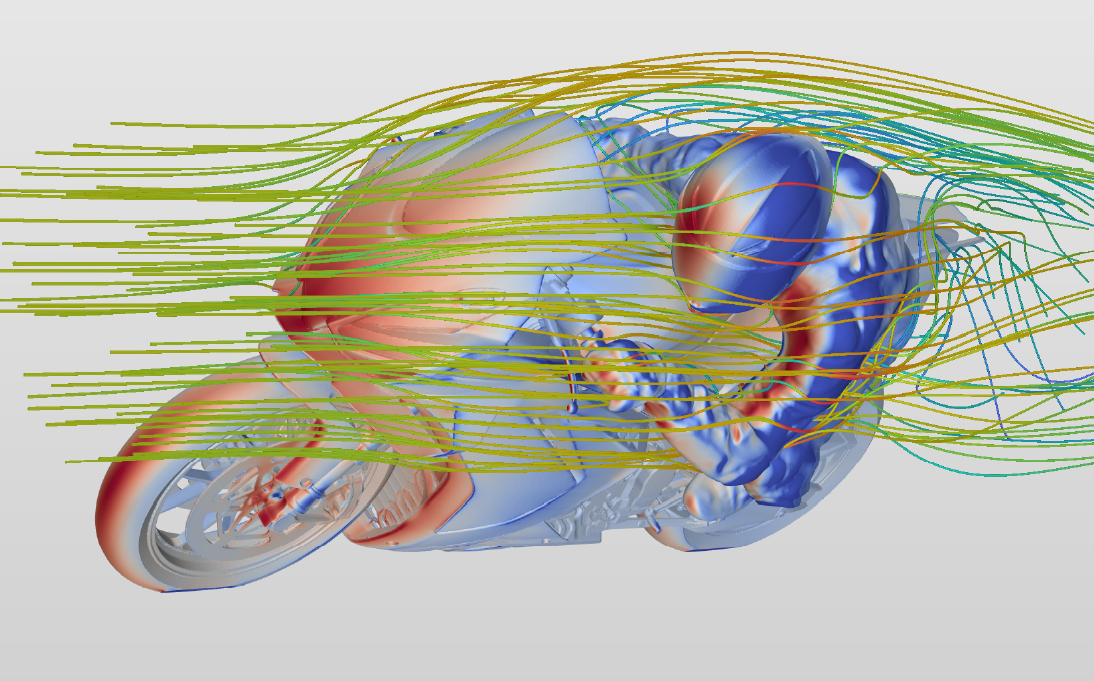
The aerodynamics arms race, once confined to the pinnacle of MotoGP, is now a defining factor in the design of production superbikes. At the same time, the adventure bike segment has exploded in popularity, introducing a new engineering challenge: balancing high-speed stability and performance with all-day rider comfort. For the Piaggio Group, home to the iconic Aprilia and Moto Guzzi brands, advanced CFD provides critical insight for optimising motorcycle aerodynamics and developing high-quality products that meet demanding performance and comfort targets.
Using ENGYS’ open-source CFD software HELYX, Piaggio’s engineers evaluated and refined aerodynamic concepts across a wide range of operating conditions for two very different objectives: track performance and touring comfort.
The Challenge in Motorcycle Aerodynamics Development: Balancing Performance and Comfort
Piaggio faced two distinct, yet equally complex, design challenges. For the Aprilia RSV4 superbike, the goal was pure performance enhancement — increasing aerodynamic efficiency to gain a competitive edge. For the new Moto Guzzi Stelvio adventure tourer, on the other hand, the primary objective was ensuring exceptional rider and passenger comfort while developing aerodynamics and styling together as complementary elements of the same design process. Each project required a CFD workflow capable of handling complex production geometries, simulating a wide range of operating conditions, and delivering accurate, actionable results on an aggressive timeline.
Simulating Complex Lean, Braking, and Acceleration Scenarios
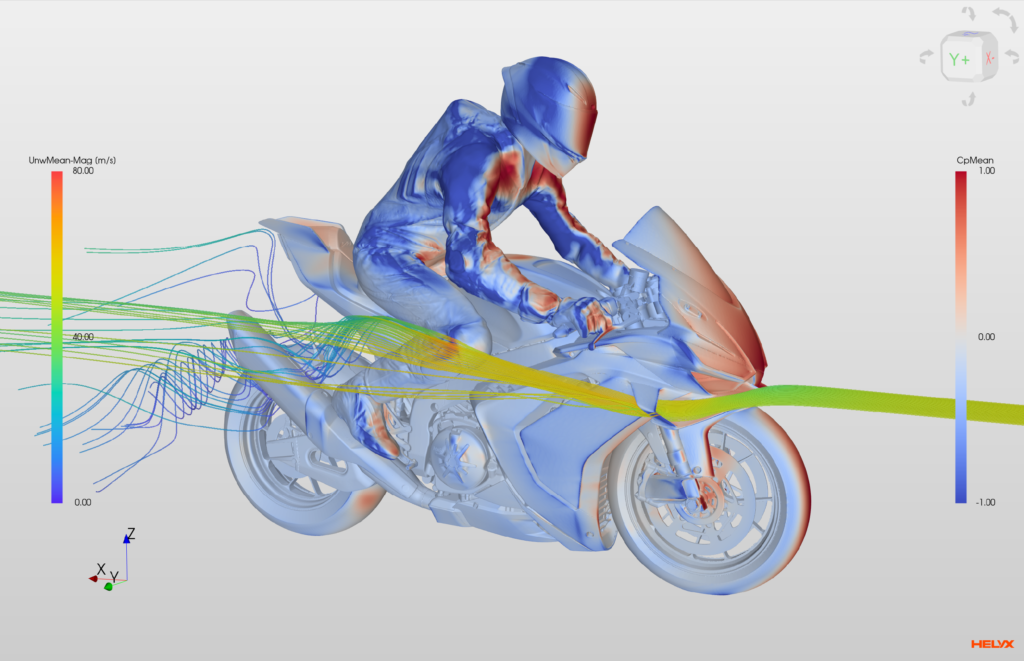
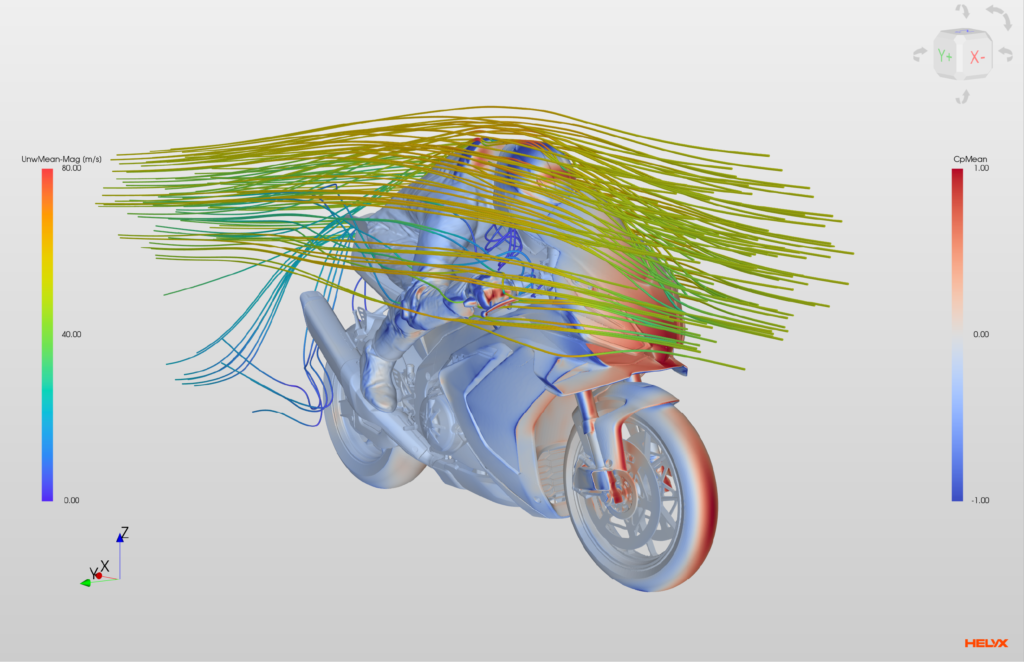
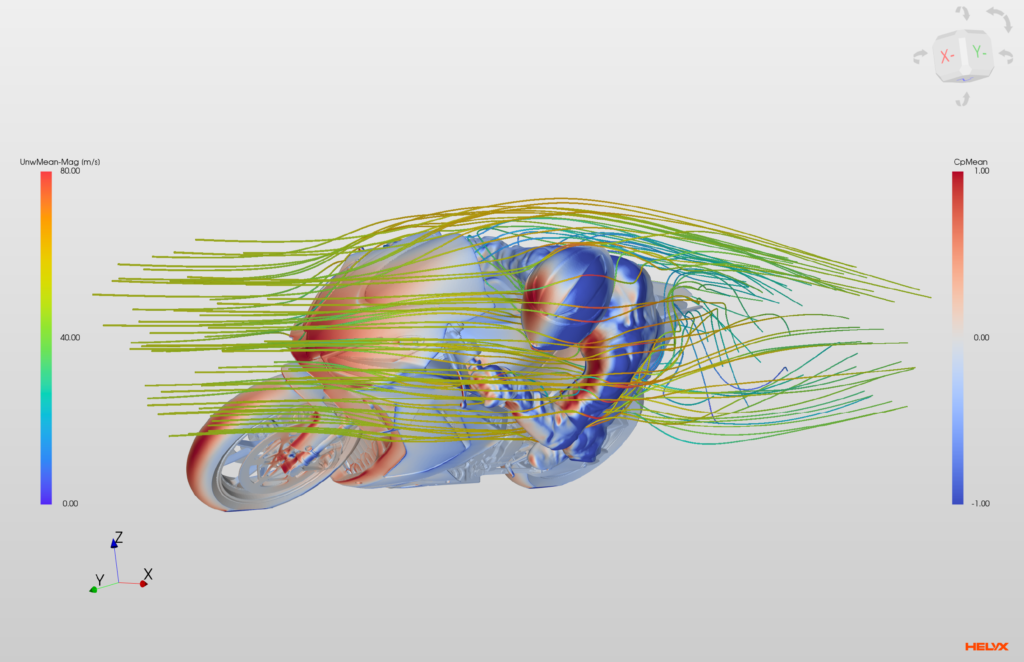
A motorcycle’s aerodynamic state is never static. Throughout a single lap, the bike and rider system experiences huge variations in geometry and orientation. To capture this reality, Piaggio’s engineers used HELYX to simulate the RSV4 across its entire operational envelope.
Using detailed rider geometries captured with a 3D scanner, the team analysed the bike’s performance in straight-line, acceleration and braking conditions. Crucially, they also paid close attention to potential understeering effects introduced by the new front wing during maximum lean, ensuring the aerodynamic updates did not come at the cost of drivability.
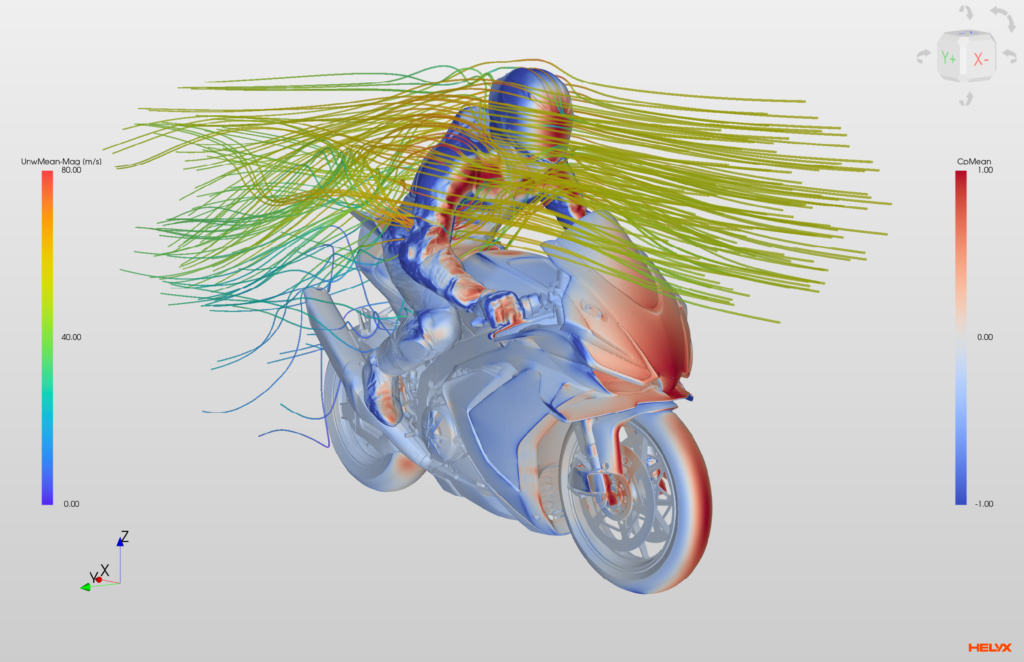
This multi-condition analysis was vital to understanding the complex trade-offs between drag, downforce and handling characteristics.
Moto Guzzi Stelvio: Using CFD to Engineer Rider Comfort
In contrast to the Aprilia RSV4’s data-driven performance targets, the Moto Guzzi Stelvio project focused on a more subjective goal: maximising rider and passenger comfort. This presented a unique challenge, as the correlation between CFD results and a rider’s real-world perception of wind protection is not straightforward. At the same time, aerodynamic performance and styling had to be developed together in harmony with the product design.
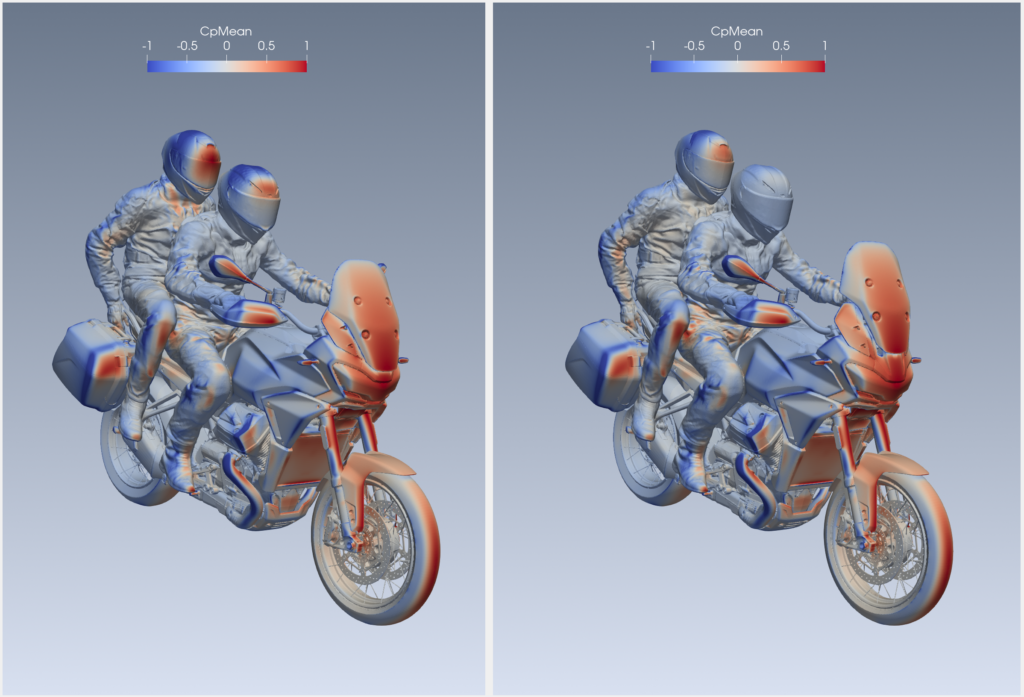
The simulation model needed to be highly accurate to reliably capture the effects of changes to the adjustable windshield’s geometry, as well as its position at the two extremes of the adjustment range.
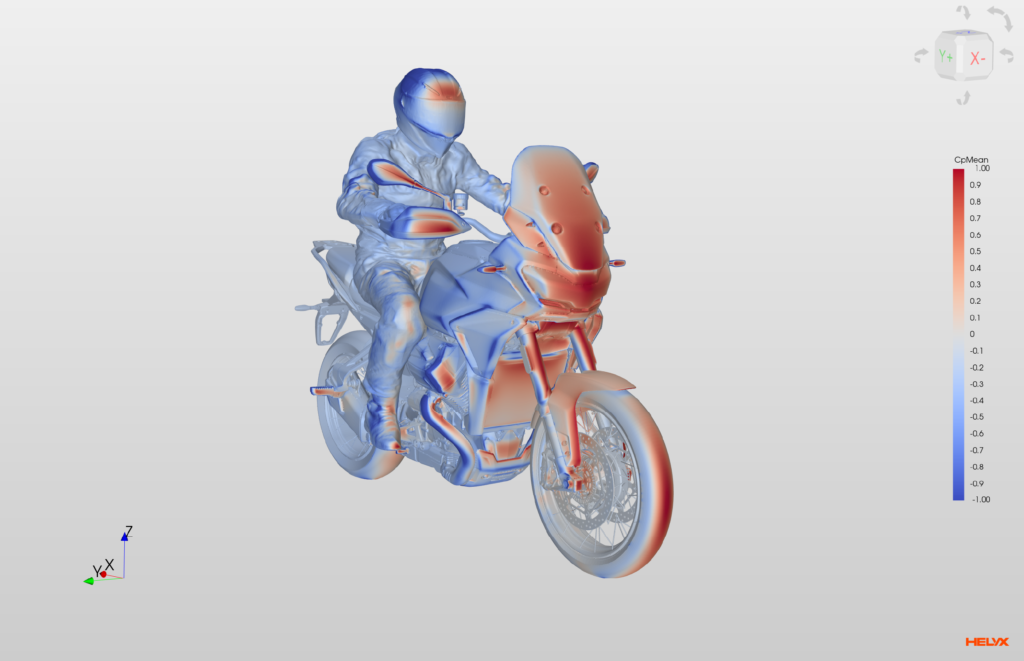
Correlating Simulation Data with Subjective Rider Feedback
The Piaggio team carried out CFD simulations for every design change on both the ‘windshield down’ and ‘windshield up’ configurations to fully understand their aerodynamic impact on the bike-rider combo. This allowed them to fine-tune the shape of the fairing and screen to create a calm pocket of air for the rider.
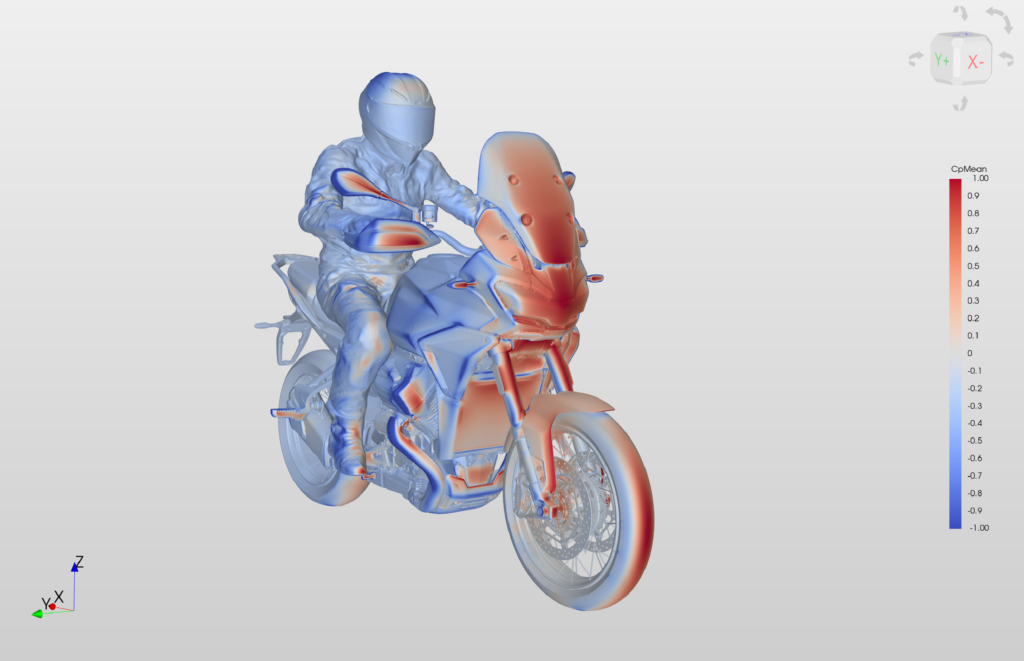
Passenger comfort was also a critical design parameter. The team evaluated the bike in a full touring setup with luggage, using 3D scans of a rider and passenger to accurately simulate the real-world use case and optimise airflow for both occupants.
How HELYX Supported Piaggio’s CFD Optimisation Workflow
For both projects, Piaggio leveraged several key capabilities within HELYX to address technical challenges and optimise aerodynamic designs. The software’s architecture and scalability provided the flexibility and computational capacity needed to manage the complex requirements of motorcycle aerodynamics development.
Halving Simulation Times with the Coupled Solver
To accelerate design iterations, Piaggio relied on the block-coupled, pressure-based solver available in the HELYX-Coupled add-on. The result was a dramatic reduction in computational time, cutting simulation times in half compared to the equivalent segregated solver. This enabled Piaggio’s engineers to run more than one design iteration per day, a critical advantage in a fast-moving development environment.
Handling Complex Geometries with a Robust Top-Down Mesher
Production motorcycle geometries are notoriously complex, often containing gaps, interferences, and intricate details that can derail a traditional meshing process. However, HELYX’s robust top-down, binary-tree mesher handled these challenges with ease, drastically reducing the time spent on geometry preparation and cleanup. This robust front-end workflow allowed the Piaggio team to reduce the total setup time for a new bike simulation to just a few days. ENGYS’ meshing technologies enable one of the most robust FV mesh generation tools for CFD in the market, built to handle real-world engineering models.
The combination of unlimited core usage, thanks to HELYX’s open-source core model, and faster solver technology proved to be a powerful formula for success. This highlights the benefits of open-source CFD for enterprise, where licensing costs do not limit scalability and simulation throughput.
Key Results: 6% Drag Reduction and Improved Rider Comfort
The CFD-driven development process established by Piaggio yielded significant, measurable improvements for both bike models described herein.
For the Aprilia RSV4, the analysis led to a 6% reduction in drag and an 8% reduction in the pitch-up moment in straight-line conditions compared to the previous model, all while preserving the bike’s outstanding agility.
For the Moto Guzzi Stelvio, the final design was ‘unanimously well received by the public for its excellent protectivity,’ a direct result of the meticulous comfort-focused CFD simulation work. The impact on Piaggio’s internal processes was equally profound.
“HELYX consolidated as a key instrument in the product development process,“ explains Lorenzo Salvucci, CFD and Aerodynamic Development Engineer at Piaggio, “enabling better results while simultaneously optimizing time and costs.“
Partner with ENGYS for Your Automotive CFD Needs
The success of the Piaggio Group with Aprilia and Moto Guzzi demonstrates the value of integrating a flexible, robust and cost-effective CFD tool into the core of the motorcycle aerodynamics development process. Whether the goal is extracting from a complex geometry product the final percentage of performance on the track or engineering high levels of comfort on the road, HELYX provides the capabilities to address these objectives accurately and dependably.
Contact the ENGYS team today for a tailored consultation on how our open-source CFD solutions can support your engineering and optimisation workflows.