TECHNICAL PAPER
Experimental and Numerical Study of Oblique Flow Effects on an Open Water SSV Propeller
A. Sciacca, N. Berthiaume, G. Loubimov, P. M. Miklavcic, T. Gillette, B. G. Knight | 2026 | 36th Symposium on Naval Hydrodynamics
Overview
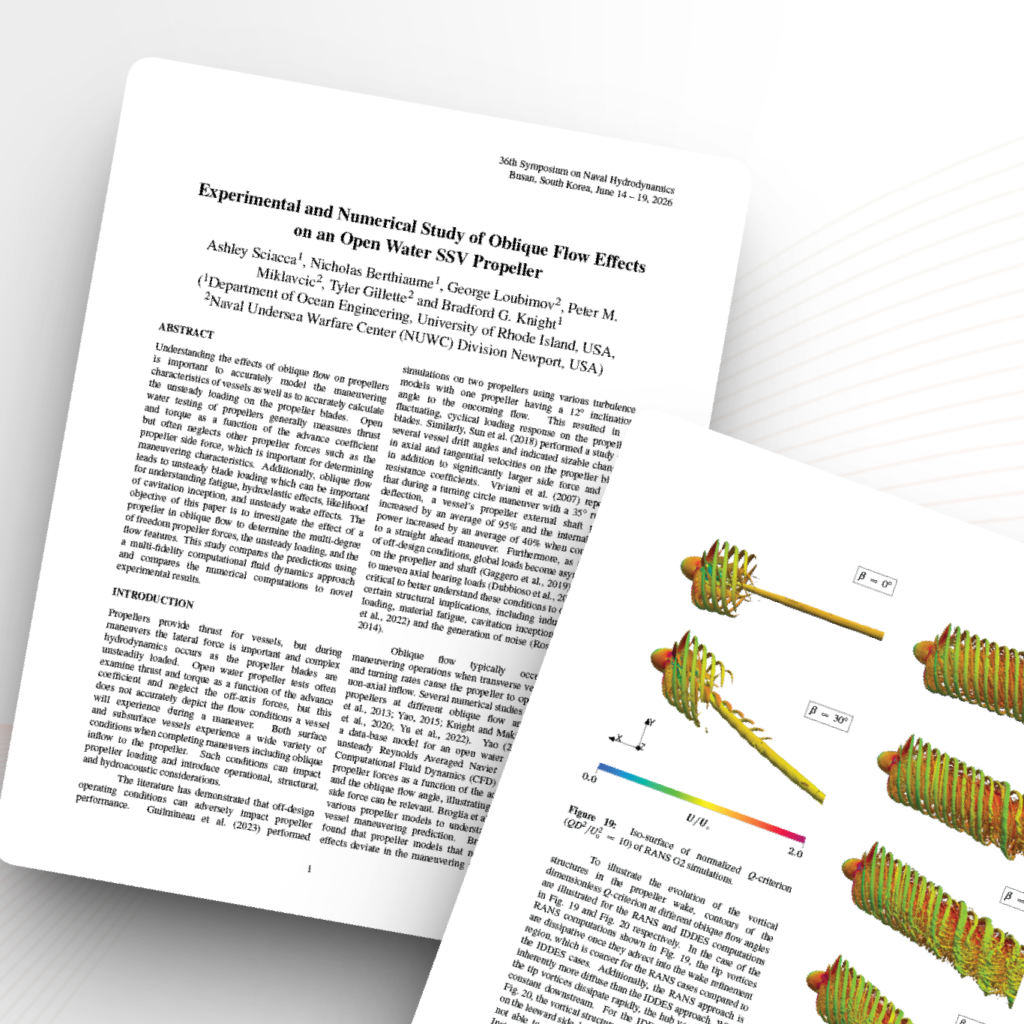
This technical paper investigates oblique flow effects on marine propellers using CFD and experimental testing. The study evaluates hydrodynamic performance, blade loading and wake dynamics under varying advance coefficients and inflow angles.
A multi-fidelity CFD approach combining unsteady RANS and Improved Delayed Detached Eddy Simulation (IDDES) is validated against experimental measurements, providing insights into propeller side forces, unsteady loading and wake behaviour relevant to manoeuvring vessels.
Abstract
Understanding the effects of oblique flow on propellers is important to accurately model the maneuvering characteristics of vessels as well as to accurately calculate the unsteady loading on the propeller blades. Open water testing of propellers generally measures thrust and torque as a function of the advance coefficient but often neglects other propeller forces such as the propeller side force, which is important for determining maneuvering characteristics.
Additionally, oblique flow leads to unsteady blade loading which can be important for understanding fatigue, hydroelastic effects, likelihood of cavitation inception, and unsteady wake effects. The objective of this paper is to investigate the effect of a propeller in oblique flow to determine the multi-degree of freedom propeller forces, the unsteady loading, and the flow features. This study compares the predictions using a multi-fidelity computational fluid dynamics approach and compares the numerical computations to novel experimental results.
What This Paper Covers
- CFD analysis of oblique flow effects on marine propellers
- Experimental validation of propeller performance in oblique flow
- Prediction of thrust, torque and propeller side force
- Analysis of unsteady blade loading and wake dynamics
- Multi-fidelity CFD using URANS and IDDES
- Comparison between numerical simulations and experiments
SHARE THIS TECHNICAL PAPER