TECHNICAL PAPER
A GPU-Accelerated AI-Based Tools Framework for CFD-Based Ship Hull Design
E. Costa, B. Di Paolo, A. Krassas, P. Geremia, J. Linford, N. Ashton, I. Pegler, R. Ranade, A. Ghasemi, M. Machowski, M. E. Biancolini | 2026 | 17th World Congress on Computational Mechanics (WCCM) / 10th European Congress on Computational Methods in Applied Sciences and Engineering (ECCOMAS)
Overview
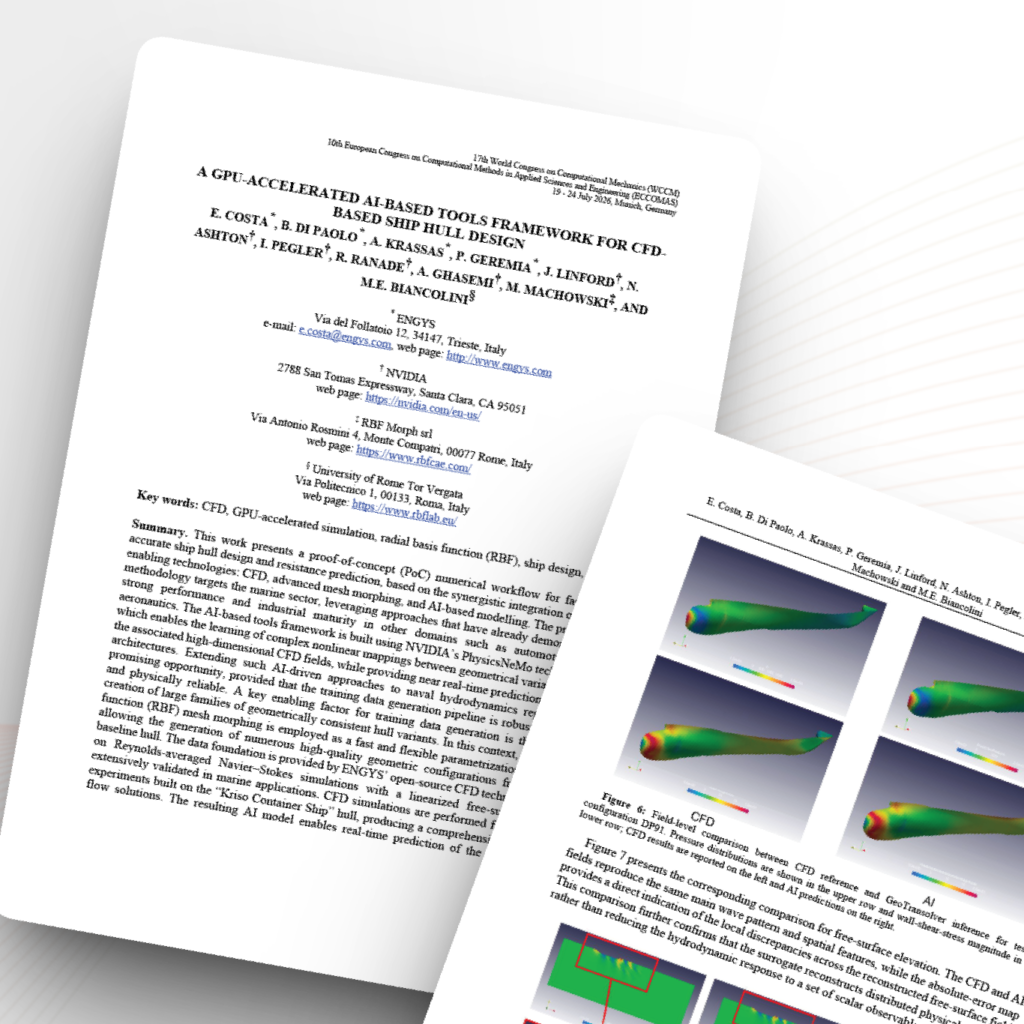
This technical paper presents a proof-of-concept numerical workflow for fast and accurate ship hull design and resistance prediction, integrating CFD, advanced RBF mesh morphing, and GPU-accelerated AI modeling. Developed within the Italian AI4TwinShip initiative, the framework leverages NVIDIA PhysicsNeMo technology (GeoTransolver) to deliver near real-time predictions of high-dimensional physical fields and calm-water resistance.
By eliminating the need for topologically consistent meshes, the proposed methodology allows independently remeshed hull variants to be evaluated in under a second while maintaining high physical fidelity for ship digital twin applications.
Abstract
This work presents a proof-of-concept (PoC) numerical workflow for fast and accurate ship hull design and resistance prediction, based on the synergistic integration of three enabling technologies: CFD, advanced mesh morphing, and AI-based modelling. The proposed methodology targets the marine sector, leveraging approaches that have already demonstrated strong performance and industrial maturity in other domains such as automotive and aeronautics. The AI-based tools framework is built using NVIDIA’s PhysicsNeMo technology, which enables the learning of complex nonlinear mappings between geometrical variations and the associated high-dimensional CFD fields, while providing near real-time predictions on GPU architectures. Extending such AI-driven approaches to naval hydrodynamics represents a promising opportunity, provided that the training data generation pipeline is robust, scalable, and physically reliable. A key enabling factor for training data generation is the efficient creation of large families of geometrically consistent hull variants. In this context, radial basis function (RBF) mesh morphing is employed as a fast and flexible parametrization technique, allowing the generation of numerous high-quality geometric configurations from a single baseline hull. The data foundation is provided by ENGYS’ open-source CFD technology, based on Reynolds-averaged Navier-Stokes simulations with a linearized free-surface model, extensively validated in marine applications. CFD simulations are performed for a design of experiments built on the “Kriso Container Ship” hull, producing a comprehensive database of flow solutions. The resulting AI model enables real-time prediction of the effects of hull geometry variations on pressure and shear stress distributions and calm-water resistance, achieving a maximum relative error below 1% on unseen configurations. The PoC, developed within the Italian AI4TwinShip initiative, demonstrates how the integration of validated CFD solvers, RBF-based geometric morphing, and GPU-accelerated AI models forms a solid foundation for future ship digital twin technologies.
What This Paper Covers
- GPU-accelerated AI surrogate modeling using NVIDIA PhysicsNeMo (GeoTransolver)
- Fast CFD simulation methodology via HELYX-Marine Linearized Free Surface (LFS) RANS solver
- Parametric hull shape modification using Radial Basis Function (RBF) surface mesh morphing via rbfCAE
- Geometry-aware learning on non-topologically consistent meshes
- A posteriori total resistance calculation from predicted surface pressure and wall shear stress
- High-accuracy prediction of hydrodynamic fields (pressure, WSS, free-surface elevation) for ship hull optimization
SHARE THIS TECHNICAL PAPER