TECHNICAL PAPER
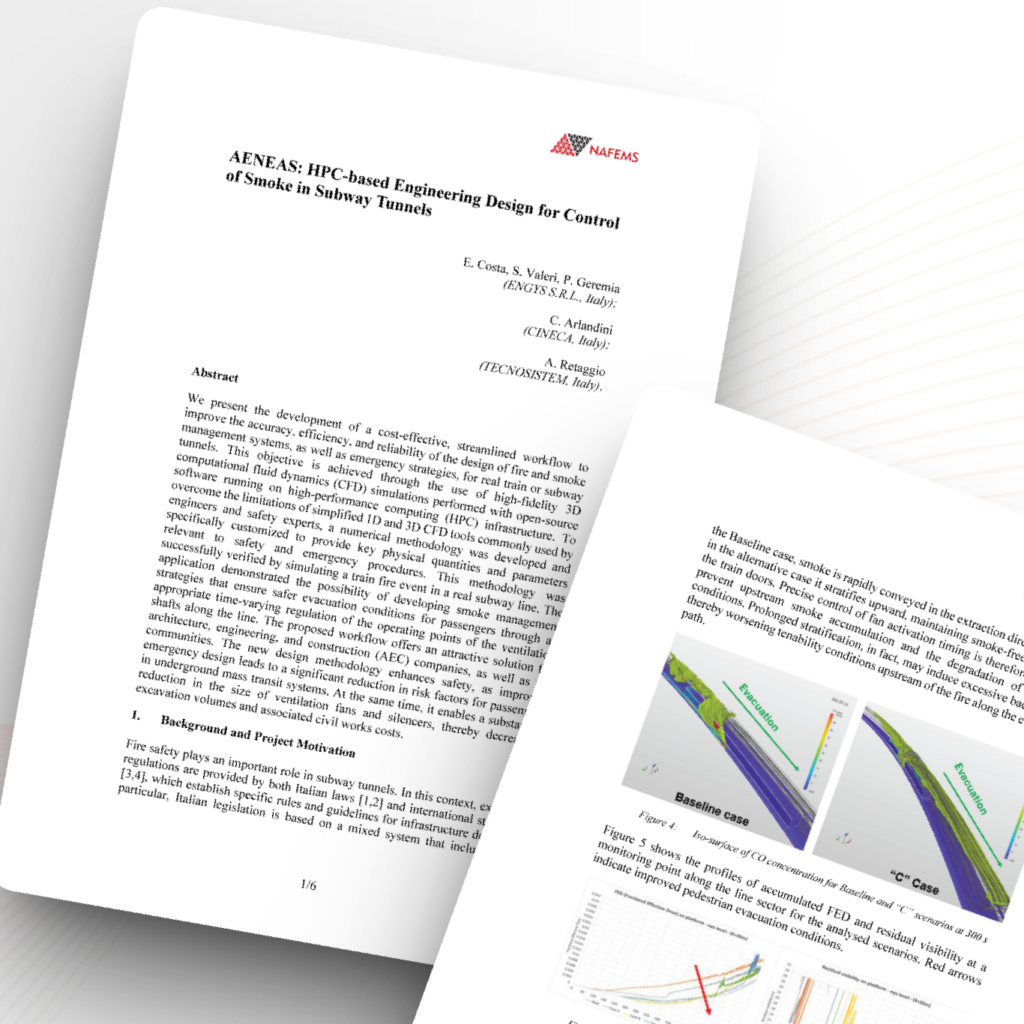
AENEAS: HPC-based Engineering Design for Control of Smoke in Subway Tunnels
E. Costa, S. Valeri, P. Geremia, C. Arlandini, A. Retaggio | 2026 | NAFEMS Italy Conference 2026
Overview
The AENEAS application presents a streamlined CFD workflow for assessing fire and smoke propagation in subway tunnels and supporting the design of ventilation and emergency strategies. Using transient 3D simulations on high-performance computing (HPC) infrastructure, the methodology evaluates conditions relevant to passenger safety, including carbon monoxide concentration, temperature, visibility and Fractional Effective Dose (FED).
Demonstrated on a planned underground railway in southern Italy, the approach compares ventilation scenarios with different fan activation timings. The results show how coordinated supply and extraction can influence smoke movement and evacuation conditions, while supporting more informed ventilation design.
Abstract
We present the development of a cost-effective, streamlined workflow to improve the accuracy, efficiency, and reliability of the design of fire and smoke management systems, as well as emergency strategies, for real train or subway tunnels. This objective is achieved through the use of high-fidelity 3D computational fluid dynamics (CFD) simulations performed with open-source software running on high-performance computing (HPC) infrastructure. To overcome the limitations of simplified 1D and 3D CFD tools commonly used by engineers and safety experts, a numerical methodology was developed and specifically customized to provide key physical quantities and parameters relevant to safety and emergency procedures. This methodology was successfully verified by simulating a train fire event in a real subway line. The application demonstrated the possibility of developing smoke management strategies that ensure safer evacuation conditions for passengers through an appropriate time-varying regulation of the operating points of the ventilation shafts along the line. The proposed workflow offers an attractive solution for architecture, engineering, and construction (AEC) companies, as well as for communities. The new design methodology enhances safety, as improved emergency design leads to a significant reduction in risk factors for passengers in underground mass transit systems. At the same time, it enables a substantial reduction in the size of ventilation fans and silencers, thereby decreasing excavation volumes and associated civil works costs.
What This Paper Covers
- Transient 3D CFD simulation of fire and smoke propagation in subway tunnels.
- HPC-based workflow for large-scale tunnel fire-safety analyses.
- Monitoring of carbon monoxide concentration, temperature, visibility and Fractional Effective Dose (FED).
- Assessment of ventilation strategies using time-varying fan activation.
- Comparison of baseline and alternative push–pull ventilation scenarios.
- Implications for passenger evacuation conditions and ventilation-system design.
SHARE THIS TECHNICAL PAPER