TECHNICAL PAPER
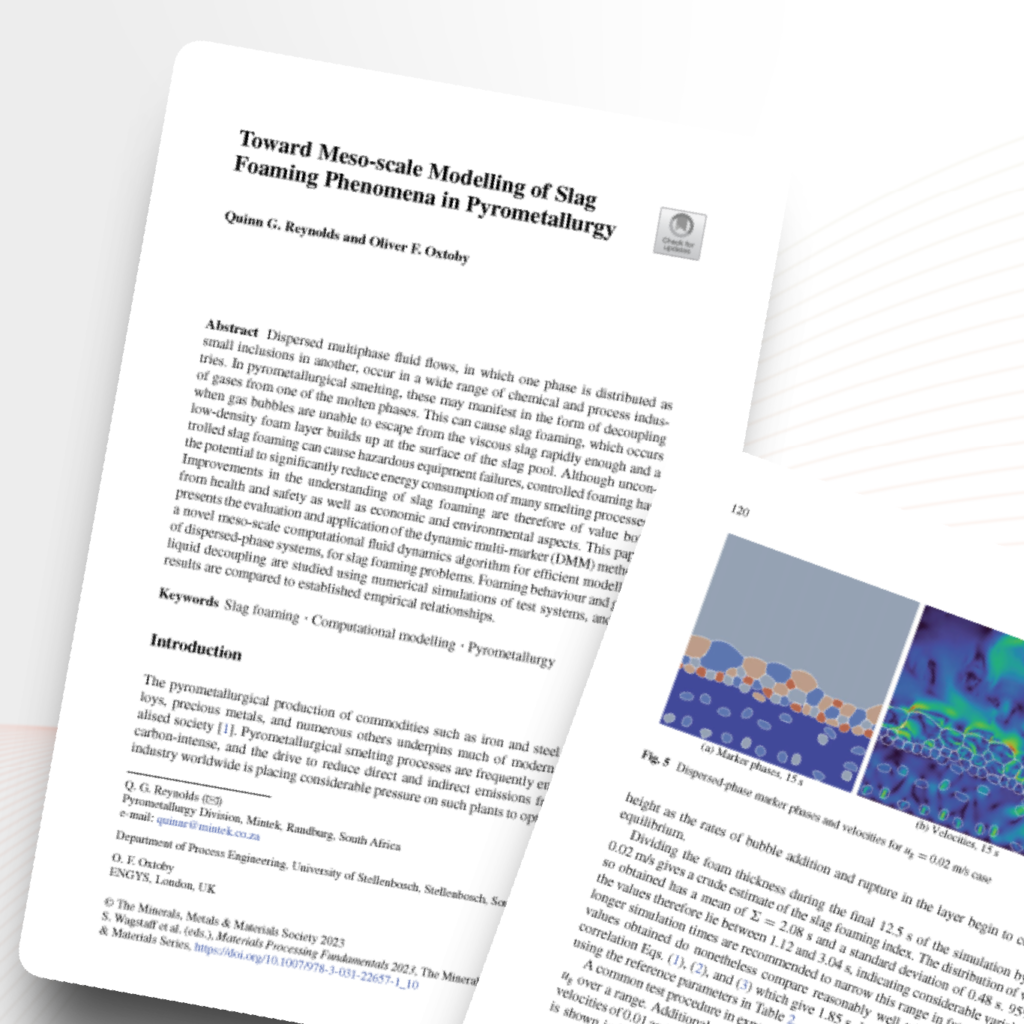
Toward meso-scale modelling of slag foaming phenomena in pyrometallurgy
Q. G. Reynolds, O. F. Oxtoby | 2023
Overview
This paper addresses meso-scale numerical modelling approaches for slag foaming phenomena in pyrometallurgical processes. The work focuses on the physical mechanisms governing gas–liquid interactions and foam formation in metallurgical slags.
The paper contributes to the understanding of slag foaming behaviour and supports the development of predictive numerical models for industrial pyrometallurgy.
Abstract
Dispersed multiphase fluid flows, in which one phase is distributed as small inclusions in another, occur in a wide range of chemical and process industries. In pyrometallurgical smelting, these may manifest in the form of decoupling of gases from one of the molten phases. This can cause slag foaming, which occurs when gas bubbles are unable to escape from the viscous slag rapidly enough and a low-density foam layer builds up at the surface of the slag pool. Although uncontrolled slag foaming can cause hazardous equipment failures, controlled foaming has the potential to significantly reduce energy consumption of many smelting processes. Improvements in the understanding of slag foaming are therefore of value both from health and safety as well as economic and environmental aspects. This paper presents the evaluation and application of the dynamic multi-marker (DMM) method, a novel meso-scale computational fluid dynamics algorithm for efficient modelling of dispersed-phase systems, for slag foaming problems. Foaming behaviour and gas–liquid decoupling are studied using numerical simulations of test systems, and the results are compared to established empirical relationships.
What This Paper Covers
- Meso-scale modelling of slag foaming phenomena
- Gas–liquid interactions in metallurgical slags
- Bubble dynamics and foam formation
- Numerical approaches for pyrometallurgical processes
- Modelling challenges and limitations
SHARE THIS TECHNICAL PAPER