TECHNICAL PAPER
Modelling of bubble population statistics in slag foaming using the dynamic multiple marker method
Q. G. Reynolds, O. F. Oxtoby, R. Mamburu | 2025 | SACAM 2025
Overview
This technical paper presents a numerical investigation of slag foaming phenomena, focusing on the statistical behaviour of bubble populations. The study applies the dynamic multiple marker method to model gas–liquid interactions relevant to pyrometallurgical processes.
The work contributes to a deeper understanding of slag foaming dynamics and supports the development of more reliable numerical tools for industrial metallurgical applications.
Abstract
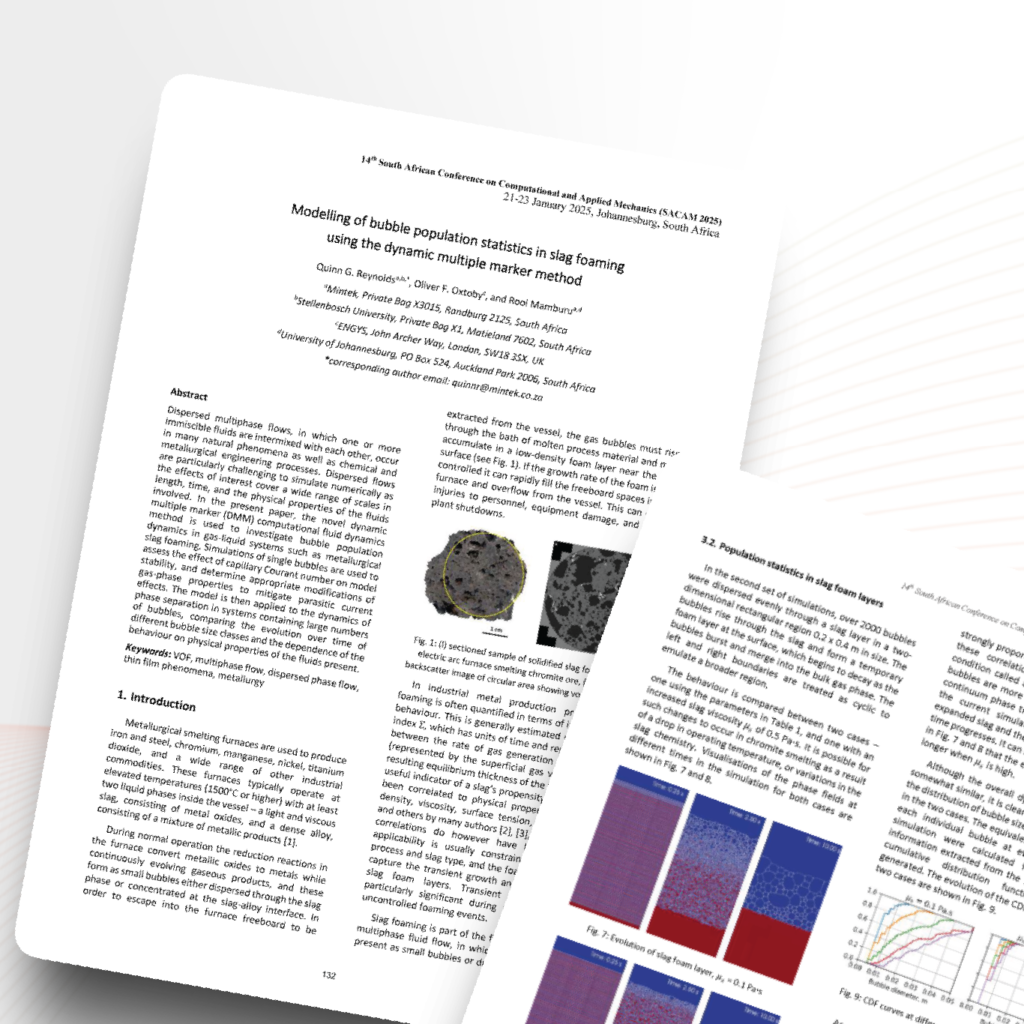
Dispersed multiphase flows, in which one or more immiscible fluids are intermixed with each other, occur in many natural phenomena as well as chemical and metallurgical engineering processes. Dispersed flows are particularly challenging to simulate numerically as the effects of interest cover a wide range of scales in length, time, and the physical properties of the fluids involved. In the present paper, the novel dynamic multiple marker (DMM) computational fluid dynamics method is used to investigate bubble population dynamics in gas-liquid systems such as metallurgical slag foaming. Simulations of single bubbles are used to assess the effect of capillary Courant number on model stability, and determine appropriate modifications of gas-phase properties to mitigate parasitic current effects. The model is then applied to the dynamics of phase separation in systems containing large numbers of bubbles, comparing the evolution over time of different bubble size classes and the dependence of behaviour on physical properties of the fluids present.
What This Paper Covers
- Numerical modelling of slag foaming phenomena
- Application of the dynamic multiple marker method
- Bubble population statistics and size distribution analysis
- Gas–liquid interaction modelling at the meso-scale
- Comparison with empirical and theoretical correlations
SHARE THIS TECHNICAL PAPER