TECHNICAL PAPER
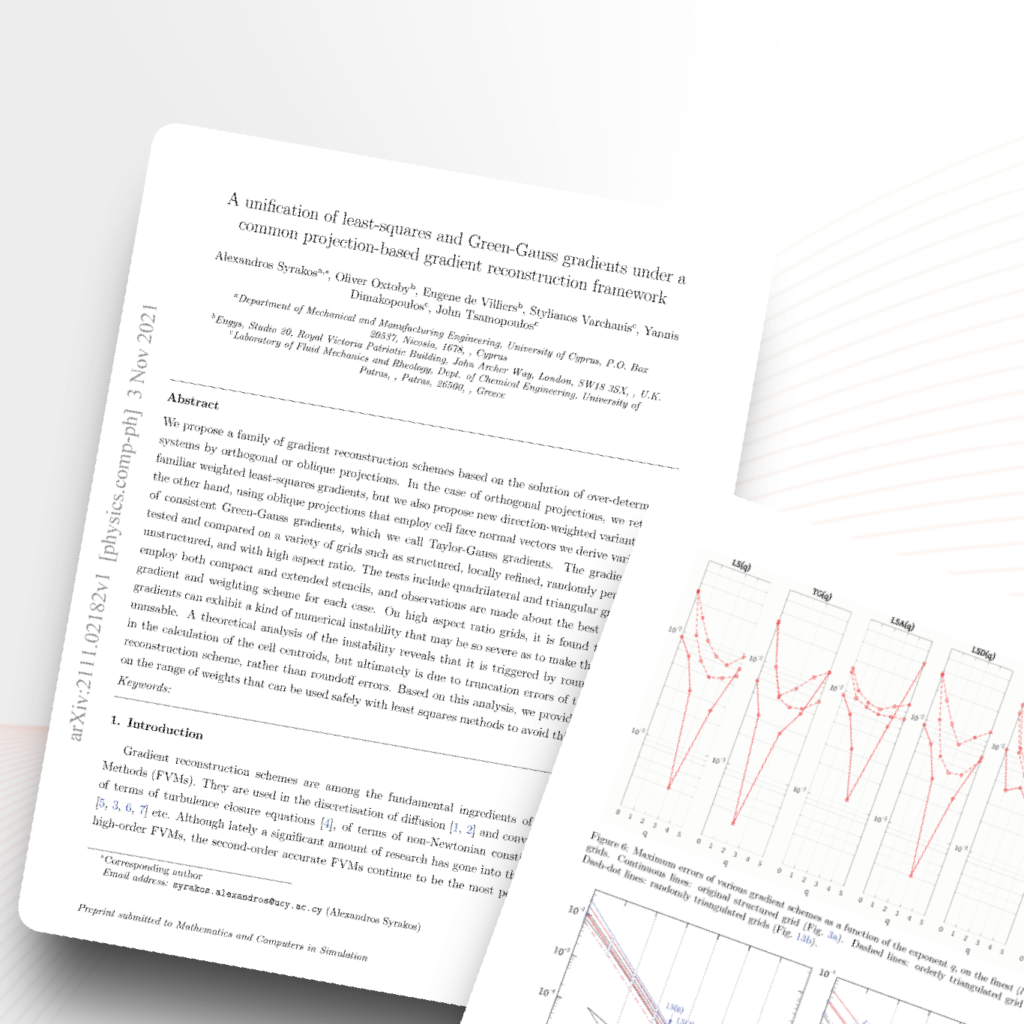
A unification of least-squares and Green-Gauss gradients under a common projection-based gradient reconstruction framework
A. Syrakos, O. Oxtoby, E. de Villiers, S. Varchanis, Y. Dimakopoulos, J. Tsamopoulos | 2021
Overview
This paper presents a unified framework for gradient reconstruction in finite-volume methods, bringing together least-squares and Green–Gauss approaches under a common projection-based formulation. The work addresses accuracy, consistency and robustness in gradient evaluation for unstructured meshes.
The proposed framework provides a clearer theoretical basis for gradient reconstruction methods widely used in computational fluid dynamics.
Abstract
We propose a family of gradient reconstruction schemes based on the solution of over-determined systems by orthogonal or oblique projections. In the case of orthogonal projections, we retrieve familiar weighted least-squares gradients, but we also propose new direction-weighted variants. On the other hand, using oblique projections that employ cell face normal vectors we derive variations of consistent Green-Gauss gradients, which we call Taylor-Gauss gradients. The gradients are tested and compared on a variety of grids such as structured, locally refined, randomly perturbed, unstructured, and with high aspect ratio. The tests include quadrilateral and triangular grids, and employ both compact and extended stencils, and observations are made about the best choice of gradient and weighting scheme for each case. On high aspect ratio grids, it is found that most gradients can exhibit a kind of numerical instability that may be so severe as to make the gradient unusable. A theoretical analysis of the instability reveals that it is triggered by roundoff errors in the calculation of the cell centroids, but ultimately is due to truncation errors of the gradient reconstruction scheme, rather than roundoff errors. Based on this analysis, we provide guidelines on the range of weights that can be used safely with least squares methods to avoid this instability.
What This Paper Covers
- Gradient reconstruction in finite-volume methods
- Least-squares and Green–Gauss gradient formulations
- Projection-based numerical framework
- Accuracy and consistency on unstructured meshes
- Implications for CFD discretisation schemes
SHARE THIS TECHNICAL PAPER